

L-Theanine and CBD Interaction: What the Research Says (2026)
|
|
Time to read 12 min
|
|
Time to read 12 min
Updated on March 6, 2026
Disclaimer: This content is for educational purposes only and is not medical advice. Consult your healthcare provider before adding any new supplement, particularly if you are on medications or hormone replacement therapy (HRT).
Quick Answer
L-theanine and CBD interact through overlapping nervous system pathways — L-theanine increases alpha brain waves and GABA activity, while CBD modulates the endocannabinoid system (ECS) through CB1 and CB2 receptors. Research suggests the combination may amplify calm focus without sedation. When stacked with THC or cannabis, L-theanine may also help soften overstimulation or anxiety.
Green tea has been making people sharper and calmer for thousands of years. You just didn't know why.
That's L-theanine. It's been quietly in your cup this whole time, the reason a strong green tea feels so different from an espresso. Focused. Clear. No edge, no jitters. Just a smooth, steady hum. Now, put that next to CBD, a cannabinoid that works through your body's master regulatory network, and you've got two compounds that don't just coexist. They talk to each other.
I'm Jaime Alefosio, Board-Certified Exponential Health Coach and PhD candidate in Natural Medicine, with over 20 years in cannabinoid research. I formulated Groove with this specific combination intentionally, not because it sounded good on a label, but because I understand the mechanism. Here's exactly what's happening, what the research actually says, and what CBD users need to know about how L-theanine interacts with CBD and THC too.
L-theanine is a non-protein amino acid found almost exclusively in tea leaves and certain mushrooms. It crosses the blood-brain barrier and modulates neurotransmitter activity — and what makes it unusual is that it promotes relaxation without sedation. It does this primarily by raising alpha brain waves: the 8–14 Hz frequency associated with meditative calm, creative flow, and focused attention.
What is L-theanine? L-theanine is a water-soluble amino acid derived from green tea (Camellia sinensis) that supports relaxed alertness by increasing alpha brain wave activity and elevating calming neurotransmitters including GABA, serotonin, and dopamine. CBD (cannabidiol) is a non-psychoactive cannabinoid derived from hemp. It works through the endocannabinoid system — your body's master network for regulating stress, sleep, appetite, inflammation, pain, and mood. Specifically, CBD is a negative allosteric modulator of CB1 receptors, meaning it doesn't activate them directly but changes how they respond to other signals.
What is the endocannabinoid system? The endocannabinoid system (ECS) is a cell-signaling network found throughout the brain, gut, immune tissue, and nervous system that regulates mood, sleep, stress response, inflammation, and metabolic function. CBD interacts with this system's receptors to support balance and homeostasis.
The interaction happens at four overlapping points:
📌Honest note: The CB1 inhibitor hypothesis for L-theanine is early-stage research. The mechanism is plausible and consistent with observed effects, but it has not been confirmed in large human trials. This is an area to watch, not a settled fact.
The answer is yes, and the evidence is better than most people realize.
The strongest data point is a 2024 double-blind, randomized, placebo-controlled trial published in ScienceDirect. Researchers enrolled 102 healthy adults and assigned them to one of four groups for eight weeks: 60mg CBD + L-theanine, 30mg CBD + L-theanine, L-theanine only, or placebo. They measured psychological health, cognitive function, serum BDNF (a marker of neuroplasticity), and immune cell function.
The combination was well-tolerated across all groups. BDNF findings pointing toward neuroplasticity support are a direction warranting continued investigation in larger, diverse populations. This is the first large controlled trial specifically on this combination, and it is not cited by a single competitor blog on this topic.
Supporting research:
📌Honest note: The 2024 RCT enrolled healthy young adults, not people with anxiety, chronic stress, or hormonal dysregulation. Extrapolating to clinical populations requires caution. Individual results vary. Anecdotal reports from practitioners and high-functioning users often exceed what controlled trials have formally confirmed.
This is the section most CBD brands won't write. But if you use cannabis, hemp flower, delta-9 gummies, traditional weed, and you want to know whether L-theanine stacks with THC, you deserve a real answer.
THC is a full CB1 agonist. It binds directly to CB1 receptors in the brain — which creates the psychoactive experience, and can also amplify anxiety, paranoia, or overstimulation at higher doses or in sensitive users.
L-theanine, based on preliminary evidence, may act as a CB1 inhibitor — modulating the same receptors THC activates through a complementary mechanism. By softening CB1 signaling, L-theanine may help:
Important: This is not a harm-reduction claim, it's a mechanistic observation. Research on L-theanine and THC specifically is limited, largely extrapolated from L-theanine's CB1 behavior and practitioner experience. This is not medical advice. Consult a healthcare provider before combining substances, especially if managing a health condition.
Queries like "theanine and CBD," "l theanine and THC," and "l theanine and weed" collectively drive over 1,500 monthly searches with almost zero quality educational content to meet them. Most brands won't address it. We think that's a disservice.
The nervous system lens matters here: cannabis and L-theanine both ultimately influence how regulated your nervous system feels. How they interact depends on dose, timing, individual biochemistry, and the specific cannabinoid profile involved. What we know is that the combination is low-risk, has a plausible mechanism, and deserves honest discussion.
HMJ Note: Hey Mary Jane products use precision-microdosed full-spectrum hemp CBD — not recreational THC, and not isolated compounds. The doses are low-and-slow by design, targeting the nervous system's natural regulatory mechanisms rather than overwhelming them. That distinction matters — both for how it feels and for legal compliance.
Effect |
L-Theanine |
CBD |
THC (cannabis / weed) |
Psych-oactive? |
No |
No |
Yes
(dose-dependent)
|
Relaxation |
✓ Alpha waves + GABA |
✓ ECS modulation |
✓ Strong (CB1 agonism) |
Focus / Clarity |
✓ High (alpha waves) |
Mild, dose-dependent |
Mixed — low may help; high may impair |
Anxiety reduction |
✓ Moderate |
✓ Moderate |
Para-doxical at high doses |
Sleep support |
Mild (relaxation prep) |
✓ Moderate (research-backed) |
✓ Short-term; may reduce REM |
Sedation risk |
Very low |
Low–moderate |
Mode-rate–high
(dose dependent)
|
Legal status (US) |
Legal OTC supplement |
Legal (hemp-derived, <0.3% THC) |
Federally restricted; state-legal in many states |
Based on research and clinical observation, CBD + L-theanine performs best in three contexts:
This is the primary use case. Neither compound at typical doses is sedating — L-theanine is specifically studied for "relaxed alertness." For high-performers, creatives, people managing burnout, or anyone who needs to be both grounded and sharp, this targets the nervous system in a way that prescription anxiolytics don't — without dependency, without the crash.
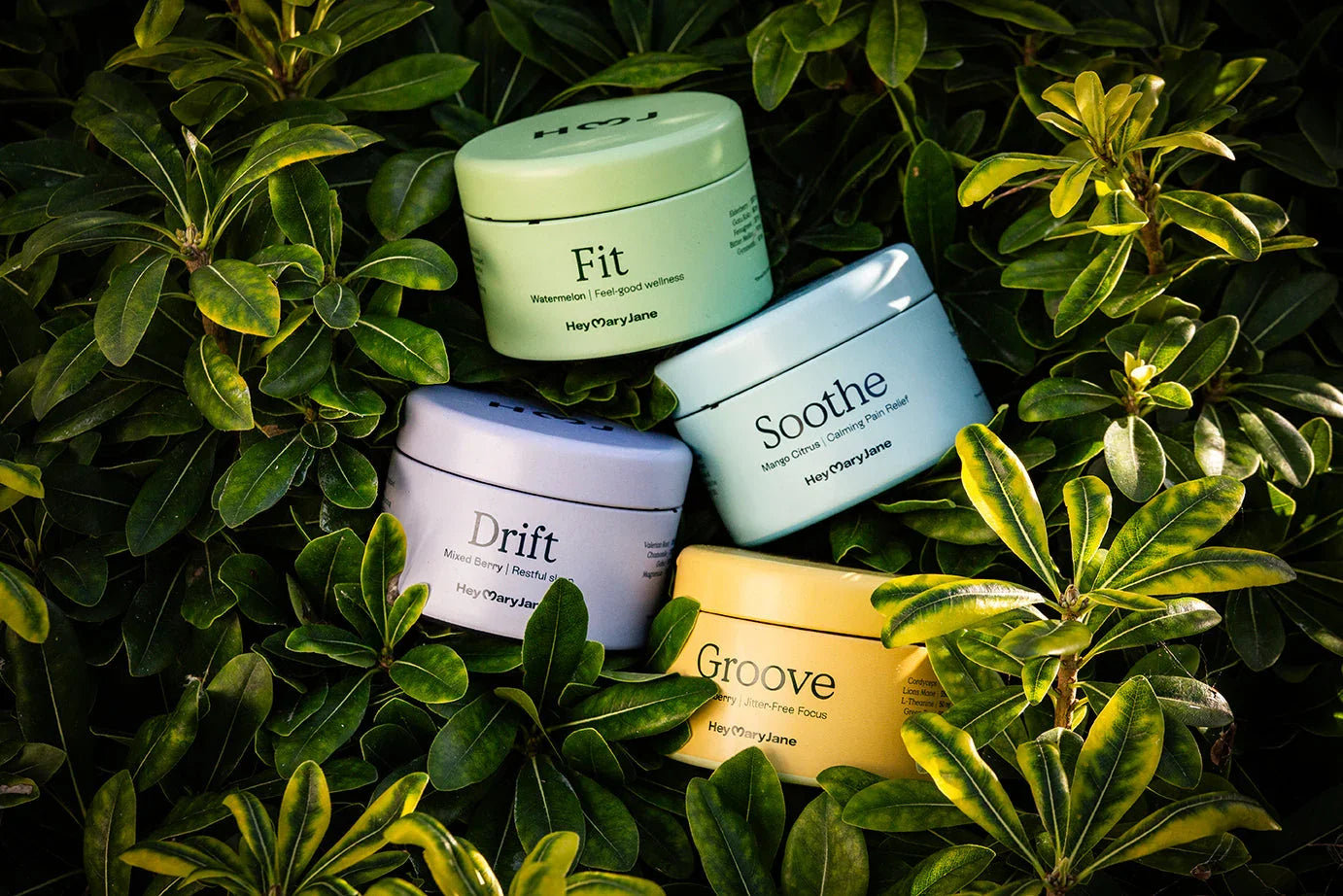
The combination is intentionally what we formulated Groove for. THCV for metabolic alertness, L-theanine for alpha-wave calm, full-spectrum CBD for ECS regulation. Three compounds. One direction: focused nervous system support.
Chronic stress elevates cortisol, which disrupts sleep, hormonal balance, and metabolism. The ECS plays a documented role in cortisol regulation. CBD's interaction with the ECS may support a healthier stress response; L-theanine's GABA-enhancing effects work upstream to reduce the brain's excitatory response before cortisol spikes occur.
For women navigating perimenopause or menopause, a life stage where cortisol dysregulation and ECS disruption directly overlap, this combination is particularly relevant. Hormonal shifts during midlife alter ECS receptor sensitivity, which is one reason this population often reports that cannabinoid support lands differently than it did earlier in life.
Neither CBD nor L-theanine is a sedative. But both support the conditions your body needs to fall and stay asleep, by reducing the nervous system arousal that keeps exhausted people lying wide awake. For people with high cortisol at night or racing thoughts at bedtime, the combination addresses the root rather than forcing sedation.
If sleep is your primary concern, consider pairing with Drift for full nighttime nervous system support.
No, they're complementary, not interchangeable, and the distinction matters for choosing the right tool.
L-theanine is a nutrient. It exists in green tea. Your body recognizes it, uses it, and excretes it cleanly. Its effects are targeted: alpha brain waves, GABA, serotonin, dopamine. Fast. Predictable.
CBD is a cannabinoid that works through the ECS — a system regulating a much broader range of functions: stress, sleep, immune response, pain perception, inflammation. Its effects are wider-reaching but also more variable across individuals based on ECS expression, prior cannabis history, and metabolism.
Neither compound has a universally established dose for their combination. Here's what research and practice suggest:
Grapefruit Rule: CBD is metabolized by the CYP450 enzyme system in the liver — the same pathway that processes many prescription medications. If your medication label says to avoid grapefruit, speak with your doctor before using CBD. This includes certain statins, blood thinners, antidepressants, and antiepileptics. L-theanine has a clean drug interaction profile and does not affect most medications.
Groove by Hey Mary Jane is precision-microdosed full-spectrum hemp CBD + L-theanine + THCV, formulated specifically for focused, daytime nervous system support. Every ingredient earns its place.
Yes, L-theanine and CBD are generally considered safe to take together. Both have well-established safety profiles at typical supplement doses and do not appear to create new risks when combined. However, CBD may interact with prescription medications metabolized by the liver if you take blood thinners, antidepressants, antiepileptics, or any medication with a grapefruit warning, consult your healthcare provider before adding CBD to your routine.
Preliminary evidence suggests L-theanine may modulate CB1 receptors, the same receptors THC activates which could help soften anxiety, racing thoughts, or overstimulation associated with higher-THC cannabis use. This is based on early mechanistic research and practitioner observation, not large controlled trials. L-theanine is a low-risk supplement worth exploring if you experience anxiety from cannabis, but speak with a healthcare provider for personalized guidance.
Most people describe a state of alert calm, relaxed but mentally clear, not drowsy. L-theanine's alpha-wave enhancement creates what researchers call "relaxed alertness," and CBD's ECS modulation supports stable mood and reduced stress reactivity. The combination is non-psychoactive. It does not produce a high. Effects typically onset within 60–90 minutes and last 3–6 hours depending on dose, form, and individual metabolism.
Both compounds appear safe for daily use based on current research. L-theanine has no established tolerance or dependence profile even at daily doses up to 400mg. CBD tolerance may develop slowly with high daily doses, but at microdose levels (5–25mg) tolerance accumulation is not typically reported. For nervous system regulation, consistent daily use is generally more effective than occasional use.
CBD is a non-psychoactive cannabinoid that modulates the ECS through negative allosteric modulation of CB1 receptors. Cannabis (containing THC) is a full CB1 agonist, it directly activates those receptors, producing psychoactive effects. L-theanine may act as a CB1 inhibitor, meaning it could complement both: supporting overall ECS tone alongside CBD, and modulating CB1 activation intensity alongside THC.
No. L-theanine is an amino acid found in green tea that works primarily through GABA, serotonin, and alpha brain wave pathways. CBD is a cannabinoid derived from hemp that works through the endocannabinoid system. They are distinct compounds with different mechanisms, but overlapping effects on calm, focus, and nervous system regulation that make them synergistic when combined.
Research on L-theanine for cognitive performance typically uses 100–200mg. For focus specifically, the combination of L-theanine with a low dose of CBD (10–25mg) appears more effective than either compound alone, based on anecdotal evidence and preliminary research. Avoid high CBD doses during daytime use at higher ranges (50mg+) they can be mildly sedating for some people.
If you've experienced anxiety or paranoia from cannabis, L-theanine and CBD may help both by modulating CB1 receptor activity and by supporting GABAergic calm. That said, the most effective strategy for cannabis-induced anxiety is dose management and choosing lower-THC products, not relying on supplements to offset overconsumption. This is not medical advice, speak with a healthcare professional for personalized guidance.
At typical doses, no. L-theanine is specifically studied for promoting relaxation without sedation. CBD at low-to-moderate doses (under 50mg) is generally non-sedating for most people. The combination is considered a daytime-friendly stack. Higher CBD doses (100mg+) may cause drowsiness in some individuals, this is a dose consideration, not a combination concern.
L-theanine and CBD are not interchangeable, they work through different mechanisms and are better understood as complementary tools. Choose L-theanine if your primary goal is sharp, calm focus. Choose CBD if you're targeting sleep, inflammation, or systemic ECS support. Choose both if you want broad nervous system regulation across mood, focus, stress, and sleep — which is exactly how Groove by Hey Mary Jane is formulated.
Jaime Alefosio BCEHC
Jaime is a seasoned entrepreneur, wellness advocate, and passionate educator, now contributing as an author and blogger for HeyMaryJane.com. With over a decade of expertise in cannabis and hemp research, use, and advocacy. Her extensive knowledge stems not only from rigorous personal research but also from hands-on experience.
In addition to her entrepreneurial achievements, Jaime has recently earned her certification as a Board-Certified Exponential Health Coach. This credential reflects her dedication to empowering others to achieve optimal health through integrative and holistic approaches. She is currently a Doctor of Natural Medicine (DNM) candidate, further deepening her expertise in cutting-edge wellness solutions.
Jaime's blogs on HeyMaryJane.com are informed by her unique blend of scientific rigor, personal experience, and an unwavering commitment to helping others. Her writings provide valuable insights into the transformative power of full-spectrum hemp products, adaptogens, and nootropics, showcasing her deep understanding of natural remedies and their potential to balance the body and enhance well-being.
As a trusted voice in the wellness community, Jaime is committed to delivering educational, authentic, and impactful content that underscores Hey Mary Jane's mission of providing clean, effective alternatives to pharmaceuticals.
FDA Disclosure: These statements have not been evaluated by the Food and Drug Administration. This product is not intended to diagnose, treat, cure, or prevent any disease. This article is for educational purposes only. Consult your healthcare provider before making changes to your wellness routine.