

Valerian Root for Sleep: What the Research Actually Says (2026)
|
|
Time to read 13 min
|
|
Time to read 13 min
Updated Sept. 8, 2026. This content is for educational purposes only and is not medical advice. Consult your healthcare provider before adding any new supplement, particularly if you are on medications.
Quick Answer: Valerian supports the GABA signalling your nervous system uses to downshift at night. It doesn't set your body clock the way melatonin does. Most research points to the benefit building over two to four weeks of consistent use rather than showing up the first night, which is why so many people decide it doesn't work.
You took it. You waited. You lay there doing the thing where you calculate how many hours you'd get if you fell asleep right now. Nothing happened, so you filed valerian under "supplements that don't work" and moved on. Almost everyone does.
Here's the part nobody puts on the bottle: you weren't doing it wrong, and it probably wasn't a dud. You were running a one-night test on something that doesn't report back for a few weeks.
Valerian root is the underground part of Valeriana officinalis, a flowering perennial from Europe and Asia, dried and extracted for use in nighttime support formulas. The NIH Office of Dietary Supplements notes that supplements are made from the roots, rhizomes and stolons, and that V. officinalis is the species used most in the US.
Which part of the plant you get matters more than most labels let on. The active compounds concentrate in the root and rhizome, not the leaf or flower. If a label just says "valerian" without specifying root, it isn't telling you much.
Which part of the plant you get matters more than most labels let on. The active compounds concentrate in the root and rhizome, not the leaf or flower. If a label just says "valerian" without specifying root, it isn't telling you much.
Extract ratios matter too, and this one trips people up. A 10:1 extract means ten parts raw root reduced down to one part finished extract. So 300mg of a 10:1 extract and 300mg of raw powdered root are not the same thing, not close. When you compare two bottles by milligrams alone, you're often comparing two different substances.
GABA is your brain's main inhibitory neurotransmitter, which means it's the signal that lets your nervous system shift from "on" to "off." When that signalling gets disrupted, the shift stops working properly, and you end up exhausted but wired. That's the pathway valerian appears to work on.
The most studied compound in it is valerenic acid. In research published in Neuropharmacology by a team at the University of Zurich, valerenic acid acted at a specific site on GABA-A receptors, and the response dropped sharply when the beta-2 or beta-3 subunit was mutated. Plainly: it seems to make the GABA signalling you already have work better, rather than flooding your system with something new.
📌 Honest Note: That work was done in mice. Animal studies point to a mechanism and tell researchers where to look next. They don't demonstrate the same thing happens in you, and they shouldn't be read that way.
Lab research from the University of Illinois at Chicago, published in Molecular Brain Research, found valerian extract and valerenic acid acting as partial agonists at the 5-HT5a serotonin receptor. That receptor clusters in the suprachiasmatic nucleus, the region that runs your sleep-wake timing.
📌 Honest Note: This one was done in vitro, meaning isolated cells rather than a living body. Lab studies show a plausible mechanism. They can't tell you what happens after you swallow something.
And worth saying plainly, because you won't read it on many product pages: the NIH fact sheet notes there's still no scientific agreement on how valerian works. Several pathways look plausible. None is settled. Anyone who tells you exactly how it works is ahead of the evidence.
This is where most articles quietly oversell. The evidence is genuinely mixed, and the honest answer depends on what you measure.
The biggest analysis so far is a 2020 systematic review and meta-analysis in the Journal of Evidence-Based Integrative Medicine, pooling 60 studies across 6,894 people. It found valerian effective for subjective improvement in insomnia, while noting the effect didn't show up on objective sleep measurements.
Read that again, because it's the crux. People reported sleeping better. The instruments measuring their sleep mostly didn't detect a matching change.
Earlier work landed in similar territory. A 2006 review in The American Journal of Medicine looked at 16 randomised placebo-controlled trials across 1,093 patients and reported that most had significant methodological problems, with doses, preparations and treatment lengths varying wildly. A 2010 meta-analysis in Sleep Medicine reached much the same conclusion about trial quality.
The most sceptical read is a 2007 clinical review in Sleep Medicine Reviews titled, bluntly, "safe but not effective." It assessed 37 studies and concluded that while valerian is safe, the evidence didn't support clinical efficacy for insomnia.
So why does the research keep arguing with itself? Mostly standardisation. Trials have used different species, different plant parts, different extraction solvents and different doses, then pooled the results as though they'd all tested the same thing. They hadn't. Two products both labelled "valerian" can differ from each other more than either differs from placebo.
What that means for you: valerian isn't a sure thing, and anyone selling it as one isn't reading the literature. It's a reasonable, well-tolerated option with a plausible mechanism, a real signal on how people say they sleep, and honest uncertainty attached. That's the whole picture.
These two sit next to each other on the shelf and get compared constantly, which hides the fact that they answer completely different questions. Melatonin is a timing signal. Valerian works on the transition itself.
| Factor | Valerian Root | Melatonin |
|---|---|---|
| What it does | Supports GABA signalling involved in downshifting | Signals circadian timing |
| Mechanism | GABA-A modulation via valerenic acid, other pathways proposed | Binds MT1/MT2 receptors as an exogenous hormone |
| Onset | Cumulative, research points to 2 to 4 weeks | Single dose, usually 30 to 90 minutes |
| Best suited to | Trouble winding down, stress-driven wakefulness | Jet lag, shift work, circadian resets |
| Hormonal | Not a hormone | Is a hormone |
| Evidence | Mixed. Subjective benefit reported, objective measures largely unchanged | Strong for circadian disorders, weaker for general insomnia |
| Morning after | Usually minimal, grogginess in a minority | Grogginess and vivid dreams commonly reported |
If your problem is a schedule problem, melatonin is the better-matched tool, and we go deeper on that in our breakdown of how timing-based and nervous system approaches to sleep differ.
If your problem is that your body won't stand down at the end of the day, timing isn't the variable. That's the question valerian sits on.
Clinical trials have most often used roughly 300mg to 600mg of valerian extract, taken 30 to 120 minutes before bed. That covers most of the studies in the meta-analyses above, though the trials varied enough that a single correct dose doesn't really exist in the literature. Three things matter more than the number.
Valerian's safety record is the strongest part of its profile, and here's the telling detail: it's the one thing the sceptical reviews and the favourable ones agree on. That 2007 Sleep Medicine Reviews analysis that questioned whether it works still described it as safe across the trials it examined.
Reported effects are generally mild. Headache, dizziness, stomach upset, daytime drowsiness. A minority of people get the opposite of what they expected and feel more alert. If that's you, valerian probably isn't your ingredient, and that's useful to know quickly.
Long-term data is thinner than the safety reputation suggests. The NIH fact sheet notes that while few adverse events have been reported, long-term safety data isn't available. An analysis in the Journal of Integrative Medicine reviewing adverse reaction reports in Australia between 2000 and 2015 looked at valerian alongside other botanicals and underlines how limited surveillance data on herbal products still is.
Talk to your clinician first, and treat these as reasons to ask rather than reasons to proceed:
Compounds processed through the same liver enzyme pathways affected by grapefruit can change how other substances clear your system. If you take prescription medication, that's a conversation with your prescriber before you add anything.
Falling asleep isn't one process. It's several running at once. Neurotransmitter signalling shifting toward inhibition, muscle tension letting go, core temperature dropping, and your stress response finally standing down. One ingredient handles one lane of a multi-lane problem.
That's the reasoning behind formulating valerian alongside things that approach the same transition from other directions instead of dosing it alone. GABA and magnesium work on inhibitory signalling and neuromuscular function. Chamomile has its own history here, which we cover in what the evidence says about chamomile and sleep.
Cannabinoids work through the endocannabinoid system, your body's own regulatory network for sleep, stress and recovery, which we get into in how the endocannabinoid system regulates everyday function.
Magnesium in particular gets paired with valerian constantly, and it has its own body of sleep research worth understanding on its own terms. That's in our breakdown of magnesium and sleep quality.
Related Reading
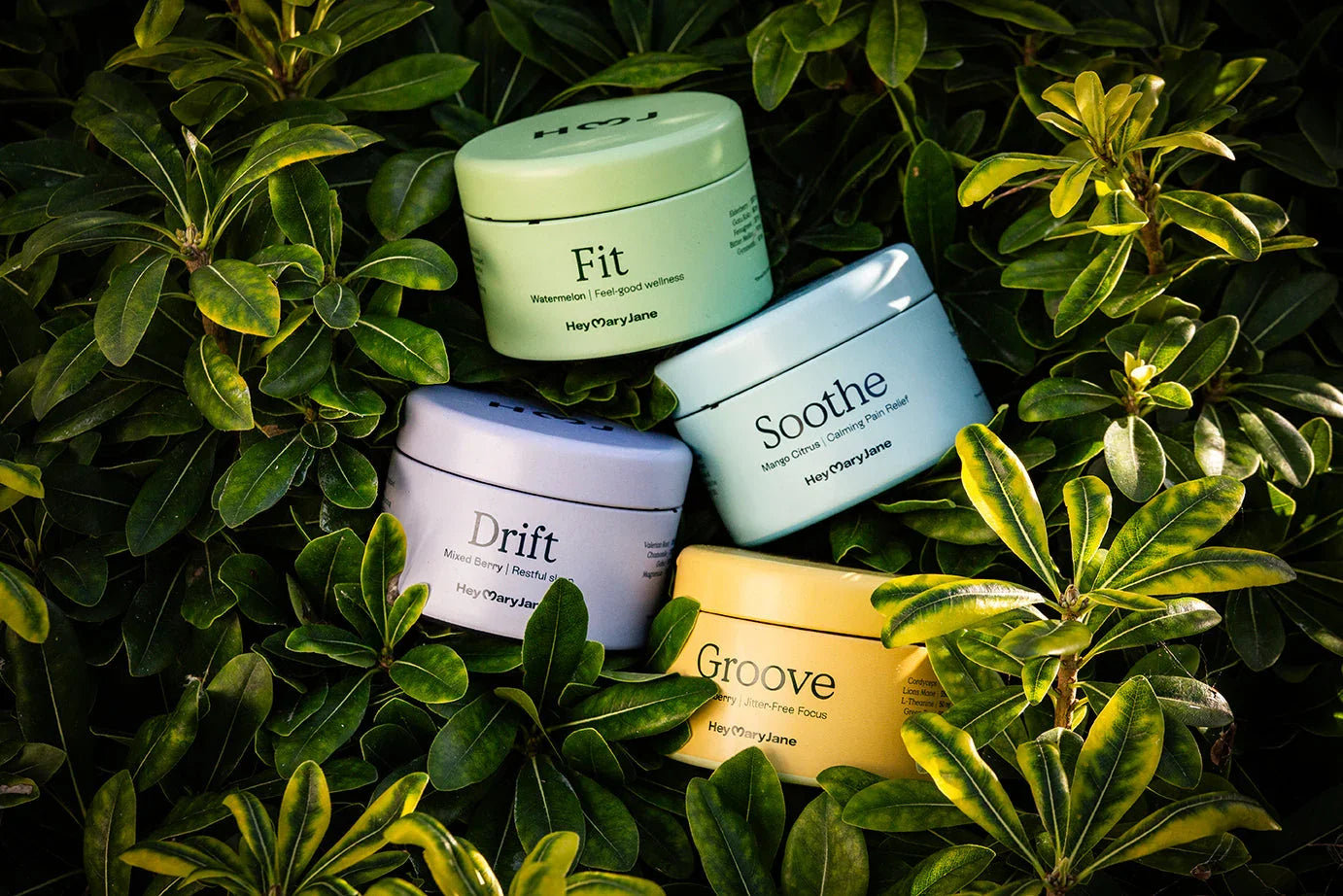
I didn't build Drift around valerian because valerian looks good on a label. I built it around what the research above actually shows. Valerian works on one lane of a transition that runs in several at once.
That's the thesis behind how we formulate. We start with the system, not the symptom. If the question is what knocks someone out, you reach for something that knocks people out. If the question is what a nervous system needs to stand down on its own, you end up somewhere different. Valerian and chamomile on inhibitory signalling, GABA and magnesium supporting the same shift from another direction, cannabinoids working through your own regulatory layer.
Every ingredient in Drift had to earn its place by mechanism. None of it is in there to make the label look impressive.
Learn about the Hey Mary Jane Collection — four precision-microdosed formulas designed around your nervous system, not your symptoms. Groove and Fit are built with THCV. Drift and Soothe use CBN and CBG.
So if you tried valerian for three nights and wrote it off, you're in extremely good company, and you also never really gave it a shot.
Two to four weeks, same time each night, and then decide. That's the actual test. If it's not for you after that, fine. At least you'll know for a real reason instead of a scheduling one.
Most research points to benefit developing over two to four weeks of consistent nightly use rather than on the first night. Some people notice something sooner, but valerian generally isn't a same-night ingredient, and a single dose isn't a fair test.
Neither is better in general, because they solve different problems. Melatonin signals circadian timing and suits jet lag, shift work and schedule resets. Valerian supports the GABA signalling involved in winding down, which suits trouble shifting out of an activated state.
Combining valerian with alcohol isn't advised. Both act on central nervous system pathways and the effects may be additive. The same caution applies to benzodiazepines and other depressants.
Combining valerian with alcohol isn't advised. Both act on central nervous system pathways and the effects may be additive. The same caution applies to benzodiazepines and other depressants.
The odour comes from volatile compounds in the root, including isovaleric acid, which develop as it dries. It's characteristic of the plant and it isn't an indicator of quality or potency in either direction. Capsules and gummies mostly bypass it.
Valerian isn't currently associated with the dependence profile seen with prescription sleep medications, and reviews generally describe it as well tolerated. Some people report unsettled sleep after stopping abruptly following extended use, so tapering is reasonable.
Most people don't report significant morning grogginess with valerian, which is one of the ways it differs from some conventional options. A minority do experience daytime drowsiness, and it's more commonly reported at higher intakes.
Clinical trials have generally given valerian 30 to 120 minutes before bed. Taking it as part of a consistent nightly routine seems to matter more than the exact minute, given that the benefit reported in research builds over weeks.
That's a conversation with your prescriber. Valerian acts on central nervous system pathways and some research has explored serotonin receptor activity, so interactions with SSRIs and related medications can't be ruled out. Don't add it to a prescription regimen without clinician input.
The honest answer is that the evidence is mixed. The largest meta-analysis found subjective improvement across 60 studies while noting objective sleep measurements didn't show a matching change, and a separate review concluded the evidence didn't support clinical efficacy. It's well tolerated, with a plausible mechanism and genuine uncertainty.
Jaime Alefosio BCEHC
Jaime is a seasoned entrepreneur, wellness advocate, and passionate educator, now contributing as an author and blogger for HeyMaryJane.com. With over a decade of expertise in cannabis and hemp research, use, and advocacy. Her extensive knowledge stems not only from rigorous personal research but also from hands-on experience.
In addition to her entrepreneurial achievements, Jaime has recently earned her certification as a Board-Certified Exponential Health Coach. This credential reflects her dedication to empowering others to achieve optimal health through integrative and holistic approaches. She is currently a Doctor of Natural Medicine (DNM) candidate, further deepening her expertise in cutting-edge wellness solutions.
Jaime's blogs on HeyMaryJane.com are informed by her unique blend of scientific rigor, personal experience, and an unwavering commitment to helping others. Her writings provide valuable insights into the transformative power of full-spectrum hemp products, adaptogens, and nootropics, showcasing her deep understanding of natural remedies and their potential to balance the body and enhance well-being.
As a trusted voice in the wellness community, Jaime is committed to delivering educational, authentic, and impactful content that underscores Hey Mary Jane's mission of providing clean, effective alternatives to pharmaceuticals.
The information on this page is provided for educational purposes and does not constitute medical advice. Hey Mary Jane products are formulated with hemp-derived cannabinoids (delta-9 THC at or below 0.3% by dry weight) under the 2018 Farm Bill framework. These statements have not been evaluated by the Food and Drug Administration. These products are not intended to diagnose, treat, cure, or prevent any disease. Individual results vary based on biochemistry, dosage, and lifestyle factors. Drug interactions with hemp-derived cannabinoids are possible, consult your healthcare provider before using if you take prescription medications, particularly blood thinners, immunosuppressants, or medications metabolized by the liver. Do not use if pregnant or nursing. Do not operate machinery while determining your individual response. Must be 21+ to purchase.


