

Mushroom Gummies Benefits: What They Do, How They Work, and Why
|
|
Time to read 16 min
|
|
Time to read 16 min
Disclaimer: This article is for educational and informational purposes only and does not constitute medical advice. The statements in this post have not been evaluated by the Food and Drug Administration. Hey Mary Jane products are not intended to diagnose, treat, cure, or prevent any disease or medical condition. Always consult a qualified healthcare professional before making changes to your supplement routine, especially if you are pregnant, nursing, taking prescription medications, or managing a chronic health condition. If you take medications metabolized by the liver (CYP450 enzymes), please consult your physician before using CBD — CBD may interact with certain medications similarly to grapefruit.
Quick Answer: Mushroom gummies are convenient, edible supplements designed to boost immune function, enhance cognitive performance (focus and memory), and increase energy levels using functional fungi extracts. Common ingredients like Lion’s Mane and Reishi offer anti-inflammatory, stress-relieving, and neuroprotective benefits, often providing a, stable energy boost without caffeine. At Hey Mary Jane, our Groove Gummies layer these mushrooms with CBD, THCV, and L-Theanine for a more complete nervous system support experience.
You've seen them everywhere in wellness influencer hauls, on dispensary shelves next to CBD tinctures, and in your friend's work bag next to her third cold brew. Mushroom gummies are having a serious moment. But before you write them off as just another wellness trend, hear this: the research behind functional mushrooms has been building for decades, and what it's showing is genuinely interesting.
My name is Jaime Alefosio. I'm a Board-Certified Exponential Health Coach (BCEHC) and a PhD Candidate in Natural Medicine at Quantum University, with over 20 years of cannabinoid research experience.
This guide covers everything you actually want to know about mushroom gummies benefits: what they do, how they work, what the science says (including where it's still developing), and what makes a formula like Groove Gummies meaningfully different from the gummies sitting in a gas station impulse bin.
Functional mushroom gummies are chewable dietary supplements made from the concentrated extracts of medicinal mushrooms — non-psychedelic fungi that have been used in traditional medicine for thousands of years and are now the subject of active scientific research. They are not magic mushroom gummies, they are not psychedelic, and they will not alter your perception of reality. What they will do, when formulated correctly, is give your body a set of bioactive compounds that may meaningfully support how your nervous system, immune system, and brain operate.
A functional mushroom is defined as a mushroom species with documented health-promoting properties beyond basic nutrition, primarily due to compounds like beta-glucan polysaccharides, triterpenoids, hericenones, erinacines, and ergothioneine. The most widely researched species include Lion's Mane (Hericium erinaceus), Cordyceps (Cordyceps militaris), Reishi (Ganoderma lucidum), Chaga (Inonotus obliquus), and Turkey Tail (Trametes versicolor).
📌 Honest Note: The research on mushroom gummies as a delivery format is relatively new. Most foundational studies used powders, capsules, or concentrated extracts. Gummies deliver the same compounds but at varying doses — making product quality (fruiting body vs. mycelium, extraction method, active compound concentration) a critical variable. We'll explain what to look for.
Here's where most mushroom gummy content on the internet stops short. They'll tell you Lion's Mane 'boosts brain power' and Cordyceps 'gives you energy,' but they rarely explain the mechanism, which is where the real story is.
Lion's Mane contains two families of unique compounds hericenones (from the fruiting body) and erinacines (from the mycelium), that research suggests can cross the blood-brain barrier and stimulate the production of nerve growth factor (NGF) and brain-derived neurotrophic factor (BDNF). A 2023 study from University of Queensland published in the Journal of Neurochemistry demonstrated that hericene A, a compound in Lion's Mane, activates a neurotrophic signaling cascade in hippocampal neurons, which are central to memory formation.
What this means practically: NGF and BDNF are proteins your brain needs to grow new neural connections, maintain existing ones, and protect against cognitive decline. Chronic stress, sleep deprivation, and age all suppress BDNF levels. Lion's Mane may help counteract this.
Cordyceps is not giving you energy the way caffeine does by blocking adenosine and masking fatigue. Instead, research suggests Cordyceps activates AMPK (adenosine monophosphate-activated protein kinase), which in turn upregulates PGC-1α the master regulator of mitochondrial biogenesis. In plain language: Cordyceps may help your cells build more energy factories, not just temporarily borrow from your reserves. A 2024 pre-clinical study found that Cordyceps extract supplementation led to an 18.4% increase in liver ATP levels and improved oxygen utilization during high-intensity exercise.
This matters for people who don't identify as athletes. If you're experiencing the kind of fatigue that comes from chronic stress, hormonal dysregulation, or burnout where your energy feels fundamentally depleted rather than just low cellular-level energy support is a meaningfully different approach than another cup of coffee.
Reishi is classified as an adaptogen, a compound that research suggests helps your body maintain homeostasis under stress by modulating the HPA (hypothalamic-pituitary-adrenal) axis your body's central stress-response system. Reishi's beta-glucans and triterpenoids have demonstrated immune-modulating properties in multiple studies, and its calming effects are believed to work in part by supporting GABA signaling, the same pathway targeted by many pharmaceutical anti-anxiety medications but without the dependency risk or sedation at functional doses.
The following mushroom gummies benefits are supported by preliminary and emerging research. No supplement should be understood as a replacement for medical care, and individual responses will vary.
Table: Ingredient mechanisms and corresponding nervous system benefits in Hey Mary Jane's Groove Gummies formula. Research citations available at end of article.
Mushroom / Ingredient |
Primary Mechanism |
Nervous System Benefit |
HMJ Formula |
Lion's Mane |
Stimulates NGF & BDNF production; promotes neuroplasticity |
Reduces brain fog; supports memory, focus, and mental clarity |
Groove Gummies |
Cordyceps |
Activates AMPK; boosts cellular ATP energy production |
Supports adrenal function; reduces fatigue; enhances oxygen utilization |
Groove Gummies |
Reishi |
Beta-glucans + triterpenoids; modulates cortisol and immune response |
Calms HPA axis overactivation; supports stress resilience |
Not in Groove — recommend Soothe |
Full-Spectrum CBD (20mg) |
Binds CB1/CB2 receptors; modulates serotonin 5-HT1A |
Regulates parasympathetic tone; calms fight-or-flight |
Groove + Soothe + Drift + Fit |
THCV (1.5mg) |
Antagonizes CB1 at low doses; activates CB2; regulates dopamine |
Supports clean focus and motivation without overstimulation |
Groove Gummies |
L-Theanine |
Increases GABA, serotonin, and dopamine; reduces excitatory glutamate |
Promotes calm alertness; pairs synergistically with CBD |
Groove Gummies |
Green Tea Extract |
Natural caffeine + catechins; supports mitochondrial function |
Alert, jitter-free energy; antioxidant neuroprotection |
Groove Gummies |
This is the question Google users are asking most, and it deserves a straight answer, not marketing speak.
The short answer: functional mushrooms work. The longer answer: gummies as a delivery format are effective when they're formulated with quality extracts, at evidence-informed doses, from the fruiting body (not mycelium on grain filler).
A 2023 double-blind, placebo-controlled study published in Nutrients journal (Docherty et al.) examined Lion's Mane supplementation in young adults and found significant improvements in cognitive function, stress, and mood after 28 days. A 2024 systematic review of 34 human studies found consistent cognitive and mood benefits from dietary patterns that included functional mushrooms across multiple age groups.
📌 Honest Note: Most of the strongest mechanistic research on mushrooms was conducted using concentrated extracts or powders at doses of 500mg–3,000mg per day. Gummies often contain lower total doses. This doesn't mean gummies don't work — but it means dose matters. Always check the label for total mushroom extract content per serving, and look for standardized beta-glucan percentages as a quality indicator.
The key variable separating effective mushroom gummies from ineffective ones:
This is one of the most searched questions on Google and it's a fair one. Here's a realistic picture based on the research and from what I hear from HMJ's community.
Functional mushroom gummies are not psychoactive. You won't feel a 'high' or any alteration in perception. What most people describe is more subtle: a gradual shift in baseline rather than an acute effect.
This is where Hey Mary Jane does something different in the mushroom gummy space and it's rooted in a systems-level understanding of how your nervous system actually works.
Your endocannabinoid system (ECS) is a master regulatory network found throughout your brain, gut, immune system, and peripheral nervous system. It governs sleep, mood, appetite, pain response, and critically your stress response. The ECS is composed of endocannabinoids (molecules your body produces), receptors (CB1, CB2, and others), and enzymes that break everything down. When the ECS is dysregulated due to chronic stress, sleep debt, or hormonal imbalance nearly every system in your body feels the effect.
Functional mushrooms work beautifully on the immune and cognitive axes. But they don't directly modulate the ECS. CBD and THCV do.
At 20mg full-spectrum, the CBD in Groove Gummies interacts with CB1 and CB2 receptors, influences serotonin 5-HT1A receptor activity, and supports the parasympathetic nervous system the 'rest-and-digest' state that chronic stress keeps most people out of. When your nervous system isn't in baseline survival mode, the cognitive-support compounds in Lion's Mane and Cordyceps have a calmer, more receptive system to work with.
THCV (tetrahydrocannabivarin) is a minor cannabinoid with a mechanism distinct from THC. At low doses (like the 1.5mg in Groove Gummies), preliminary research suggests THCV may antagonize CB1 receptors and activate CB2, modulate dopamine pathways involved in executive function, and support clean, alert focus without overstimulation. A 2021 review in Cannabis and Cannabinoid Research highlighted THCV's potential as a neuroprotective and metabolically active cannabinoid. This is why people who take Groove Gummies describe a state that's different from caffeine, more 'in the zone' than 'wired.'
L-Theanine is a naturally occurring amino acid found predominantly in green tea. Research suggests it increases GABA, serotonin, and dopamine levels while reducing excitatory glutamate activity promoting what neuroscientists call 'relaxed alertness,' a state measured by increased alpha brain wave activity. When paired with CBD (which also supports GABAergic signaling), L-Theanine's calming effects are amplified without inducing drowsiness. This is the science behind why Groove Gummies produce focus without anxiety.
The HMJ philosophy is low-and-slow starting with a minimal effective dose and building from there. For functional mushrooms and cannabinoids alike, this is the approach most aligned with how these compounds actually work (cumulatively, not acutely).
The primary benefits of functional mushroom gummies include cognitive support (improved focus and memory via Lion's Mane), natural energy enhancement (cellular ATP support via Cordyceps), stress resilience (HPA axis modulation via Reishi), immune system support (beta-glucan activation), and antioxidant protection (Chaga, Turkey Tail). When combined with cannabinoids like CBD and THCV, as in Hey Mary Jane's Groove Gummies, the benefits extend to nervous system regulation and ECS support. Preliminary research suggests consistent daily use for 3–4 weeks is needed to assess full effect.
Functional mushroom gummies are made from concentrated extracts of medicinal mushroom species — most commonly Lion's Mane, Cordyceps, Reishi, Chaga, and Turkey Tail — combined with a gummy base of pectin or gelatin, and natural flavorings. Quality varies significantly by brand. Look for products that specify fruiting body extract (not mycelium biomass), disclose total extract mg per mushroom, list beta-glucan percentage, and carry third-party testing certificates. Hey Mary Jane's Groove Gummies also include cannabinoids (CBD, THCV, THC at 1mg) and adaptogens (L-Theanine, Green Tea) for a comprehensive formula.
Yes, functional mushrooms have substantial scientific support — though most definitive research used powders or capsules at clinical doses, and mushroom gummy research specifically is still emerging. Lion's Mane has demonstrated NGF and BDNF stimulation in multiple peer-reviewed studies. Cordyceps has shown ATP and oxygen utilization improvements. Reishi has documented immune-modulating and stress-adaptive properties. Whether a specific gummy product delivers these benefits depends entirely on its formulation quality — dose, extraction method, and whether it uses fruiting body or mycelium.
Functional mushroom gummies are not psychoactive and produce no 'high' or altered perception. Most people experience subtle, gradual improvements over several weeks of consistent use: reduced brain fog, more stable energy, and greater stress resilience. The timeline is typically 2–4 weeks for noticeable cognitive effects and 4–8 weeks for immune and adaptogen effects to compound. If your formula includes cannabinoids (as Groove Gummies does), you may notice a calm, alert, focused state within 20–30 minutes of each dose due to CBD and THCV activity.
Yes — but differently from caffeine. Cordyceps mushrooms support energy at the cellular level by activating AMPK, which promotes mitochondrial biogenesis (the creation of more cellular energy factories). This produces a steadier, more sustainable energy curve without the spike-and-crash of stimulants. Research suggests Cordyceps may also improve oxygen utilization, which supports both physical endurance and mental stamina. In Groove Gummies, Cordyceps is paired with THCV (a focus cannabinoid) and Green Tea extract for a layered clean-energy effect.
Functional mushroom gummies are generally well-tolerated by most healthy adults. Reported side effects are rare and typically mild, including occasional digestive discomfort in people sensitive to high-fiber compounds. People with mushroom allergies should avoid them. If you are pregnant, nursing, immunocompromised, or on prescription medications — particularly immunosuppressants or blood thinners — consult a healthcare provider before use. Formulas that include CBD may interact with medications processed by liver CYP450 enzymes. Always start with a low dose and monitor your response.
Preliminary research suggests yes, through several pathways. Lion's Mane may support mood by stimulating BDNF, which is associated with reduced depression symptoms in clinical studies. Reishi may calm the nervous system by supporting GABA activity and regulating cortisol. When mushrooms are combined with CBD (which interacts with serotonin 5-HT1A receptors) and L-Theanine (which increases dopamine and GABA), the mood support potential becomes multi-pathway. Groove Gummies by Hey Mary Jane are specifically formulated with this layered approach. These statements are not intended to diagnose or treat any mood disorder.
Hey Mary Jane's Groove Gummies are in a category of their own: they combine functional mushrooms (Lion's Mane + Cordyceps) with precision-microdosed cannabinoids (20mg full-spectrum CBD, 1.5mg THCV, 1mg THC) and adaptogens (L-Theanine + Green Tea extract). No other mainstream mushroom gummy brand combines these three pillars in a single, microdosed formula. While standard mushroom gummies address cognitive and immune support, Groove Gummies also target the endocannabinoid system — the body's master regulatory network — for a more complete nervous system support approach. Mary Jane's mushroom gummies are manufactured in Utah, USA with third-party testing.
Timeline varies by compound. Cannabinoids like CBD and THCV in Groove Gummies produce noticeable effects within 20–30 minutes and last 3–5 hours. Functional mushroom compounds (hericenones, beta-glucans, cordycepin) are adaptogenic — meaning their full benefits build over weeks of consistent use. Most people report a meaningful shift in focus, energy stability, and stress resilience after 3–4 weeks of daily use. Immune support benefits may take 6–8 weeks to fully establish. Consistency matters more than dose size when it comes to adaptogens.
Functional mushrooms are not hype. The science while still growing points consistently toward real, meaningful support for cognitive function, energy, immune resilience, and stress response. What makes the difference is formulation: dose, extraction quality, and what's layered alongside.
At Hey Mary Jane, we're doing something the mushroom gummy space hasn't seen before: combining the adaptogenic intelligence of Lion's Mane and Cordyceps with the nervous-system precision of microdosed CBD and THCV, and the calm-focus synergy of L-Theanine. It's not a mushroom gummy plus a CBD gummy. It's one formula built around a single idea giving your nervous system what it actually needs to regulate, focus, and recover.
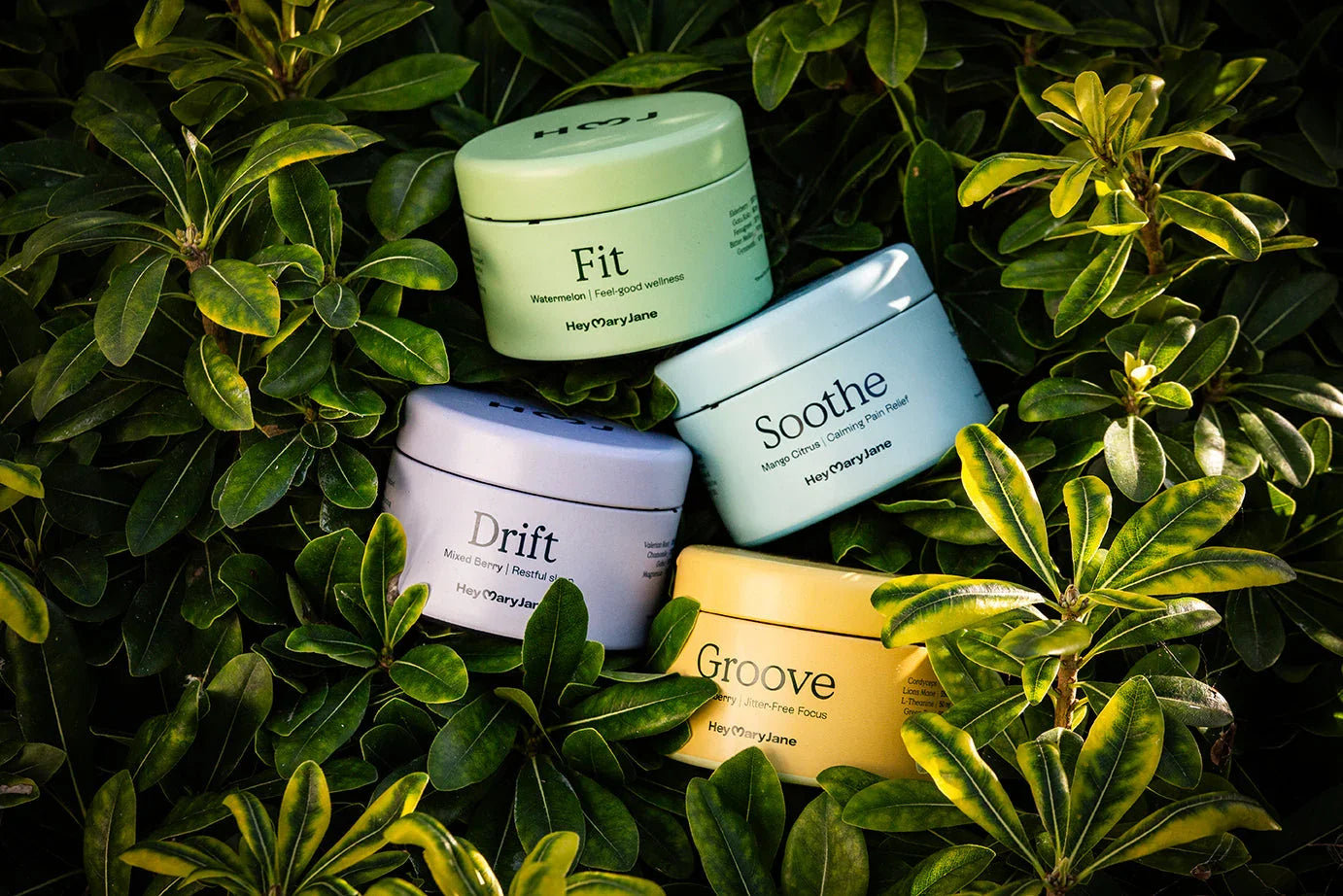
Start with Groove if focus and daily energy are your primary goals. Add Soothe if you're navigating chronic stress or inflammation. Reach for Drift when it's time to let the day go and sleep like you mean it. And if hormonal or metabolic support is on your list, Fit is built for that.
Low and slow. Consistent and intentional. That's the HMJ way.
→ Try Groove Gummies | Full-Spectrum CBD + THCV + Lion's Mane + Cordyceps
1. Docherty S, et al. (2023). The Acute and Chronic Effects of Lion's Mane Mushroom Supplementation on Cognitive Function, Stress and Mood in Young Adults. Nutrients, 15(22), 4842.
2. Martinez-Marmol R, et al. (2023). Hericene A from Hericium erinaceus Activates a Pan-Neurotrophic Pathway in Central Hippocampal Neurons. University of Queensland. Journal of Neurochemistry.
Vetvicka V & Vetvickova J. (2014). Immune-enhancing effects of Maitake (Grifola frondosa) and Shiitake (Lentinula edodes) extracts. Annals of Translational Medicine, 2(2), 14. https://doi.org/10.3978/j.issn.2305-5839.2014.01.05
Hirsch KR, et al. (2017). Cordyceps militaris improves tolerance to high-intensity exercise after acute and chronic supplementation. Journal of Dietary Supplements, 14(1), 42–53. https://doi.org/10.1080/19390211.2016.1203386
Jadoon KA, et al. (2016). Efficacy and Safety of Cannabidiol and Tetrahydrocannabivarin on Glycemic and Lipid Parameters in Patients With Type 2 Diabetes. Diabetes Care, 39(10), 1777–1786. https://doi.org/10.2337/dc16-0650
6. Blessing EM, et al. (2015). Cannabidiol as a Potential Treatment for Anxiety Disorders. Neurotherapeutics, 12(4), 825–836.
7. Hidese S, et al. (2019). Effects of L-Theanine Administration on Stress-Related Symptoms and Cognitive Functions in Healthy Adults. Nutrients, 11(10), 2362.
8. Guggenheim AG, et al. (2014). Immune Modulation From Five Major Mushrooms. Integrative Medicine, 13(1), 32–44. (Beta-glucan/immune review.)
FDA Disclaimer: These statements have not been evaluated by the Food and Drug Administration. Hey Mary Jane products are not intended to diagnose, treat, cure, or prevent any disease. This content is provided for educational purposes only and reflects the author's research-informed perspective. Individual results may vary. Consult a qualified healthcare professional before beginning any new supplement regimen. If you take medications processed by CYP450 liver enzymes, consult your physician before using CBD-containing products.
Jaime Alefosio BCEHC
Jaime is a seasoned entrepreneur, wellness advocate, and passionate educator, now contributing as an author and blogger for HeyMaryJane.com. With over a decade of expertise in cannabis and hemp research, use, and advocacy. Her extensive knowledge stems not only from rigorous personal research but also from hands-on experience.
In addition to her entrepreneurial achievements, Jaime has recently earned her certification as a Board-Certified Exponential Health Coach. This credential reflects her dedication to empowering others to achieve optimal health through integrative and holistic approaches. She is currently a Doctor of Natural Medicine (DNM) candidate, further deepening her expertise in cutting-edge wellness solutions.
Jaime's blogs on HeyMaryJane.com are informed by her unique blend of scientific rigor, personal experience, and an unwavering commitment to helping others. Her writings provide valuable insights into the transformative power of full-spectrum hemp products, adaptogens, and nootropics, showcasing her deep understanding of natural remedies and their potential to balance the body and enhance well-being.
As a trusted voice in the wellness community, Jaime is committed to delivering educational, authentic, and impactful content that underscores Hey Mary Jane's mission of providing clean, effective alternatives to pharmaceuticals.


